Prime Unit Identity
We are going to assign prime identity as the Standard Model to stimulate a quantum field model called eQuantum for the four (4) known fundamental forces.
This section is referring to wiki page- of zone section-0 that is inherited from the zone section- by prime spin- and span- with the partitions as below.
- Addition Zones (0-18)
- Multiplication Zones (18-30)
- Symmetrical Breaking (spin 8)
- The Angular Momentum (spin 9)
- Entrypoint of Momentum (spin 10)
- The Mapping of Spacetime (spin 11)
- Similar Order of Magnitude (spin 12)
- Searching for The Graviton (spin 13)
- Elementary Retracements (spin 14)
- Recycling of Momentum (spin 15)
- Exchange Entrypoint (spin 16)
- The Mapping Order (spin 17)
- Magnitude Order (spin 18)
- Exponentiation Zones (30-36)
- Identition Zones (36-102)
- Theory of Everything (span 12)
- Everything is Connected (span 11)
- Truncated Perturbation (span 10)
- Quadratic Polynomials (span 9)
- Fundamental Forces (span 8)
- Elementary Particles (span 7)
- Basic Transformation (span 6)
- Hidden Dimensions (span 5)
- Parallel Universes (span 4)
- Vibrating Strings (span 3)
- Series Expansion (span 2)
- Wormhole Theory (span 1)
This presentation was inspired by theoretical works from Hideki Yukawa who in 1935 had predicted the existence of mesons as the carrier particles of strong nuclear force.
Addition Zones
Below is the list of primes spin along with their position, the polarity of the number, and the prime hexagon's overall rotation within 1000 numbers.
The Prime Hexagon is a mathematical structure developed by mathematician Tad Gallion. A Prime Hexagon is formed when integers are sequentially added to a field of tessellating equilateral triangles, where the path of the integers is changed whenever a prime number is encountered (GitHub: kaustubhcs/prime-hexagon).
5, 2, 1, 0
7, 3, 1, 0
11, 4, 1, 0
13, 5, 1, 0
17, 0, 1, 1
19, 1, 1, 1
23, 2, 1, 1
29, 2, -1, 1
31, 1, -1, 1
37, 1, 1, 1
41, 2, 1, 1
43, 3, 1, 1
47, 4, 1, 1
53, 4, -1, 1
59, 4, 1, 1
61, 5, 1, 1
67, 5, -1, 1
71, 4, -1, 1
73, 3, -1, 1
79, 3, 1, 1
83, 4, 1, 1
89, 4, -1, 1
97, 3, -1, 1
101, 2, -1, 1
103, 1, -1, 1
107, 0, -1, 1
109, 5, -1, 0
113, 4, -1, 0
127, 3, -1, 0
131, 2, -1, 0
137, 2, 1, 0
139, 3, 1, 0
149, 4, 1, 0
151, 5, 1, 0
157, 5, -1, 0
163, 5, 1, 0
167, 0, 1, 1
173, 0, -1, 1
179, 0, 1, 1
181, 1, 1, 1
191, 2, 1, 1
193, 3, 1, 1
197, 4, 1, 1
199, 5, 1, 1
211, 5, -1, 1
223, 5, 1, 1
227, 0, 1, 2
229, 1, 1, 2
233, 2, 1, 2
239, 2, -1, 2
241, 1, -1, 2
251, 0, -1, 2
257, 0, 1, 2
263, 0, -1, 2
269, 0, 1, 2
271, 1, 1, 2
277, 1, -1, 2
281, 0, -1, 2
283, 5, -1, 1
293, 4, -1, 1
307, 3, -1, 1
311, 2, -1, 1
313, 1, -1, 1
317, 0, -1, 1
331, 5, -1, 0
337, 5, 1, 0
347, 0, 1, 1
349, 1, 1, 1
353, 2, 1, 1
359, 2, -1, 1
367, 1, -1, 1
373, 1, 1, 1
379, 1, -1, 1
383, 0, -1, 1
389, 0, 1, 1
397, 1, 1, 1
401, 2, 1, 1
409, 3, 1, 1
419, 4, 1, 1
421, 5, 1, 1
431, 0, 1, 2
433, 1, 1, 2
439, 1, -1, 2
443, 0, -1, 2
449, 0, 1, 2
457, 1, 1, 2
461, 2, 1, 2
463, 3, 1, 2
467, 4, 1, 2
479, 4, -1, 2
487, 3, -1, 2
491, 2, -1, 2
499, 1, -1, 2
503, 0, -1, 2
509, 0, 1, 2
521, 0, -1, 2
523, 5, -1, 1
541, 5, 1, 1
547, 5, -1, 1
557, 4, -1, 1
563, 4, 1, 1
569, 4, -1, 1
571, 3, -1, 1
577, 3, 1, 1
587, 4, 1, 1
593, 4, -1, 1
599, 4, 1, 1
601, 5, 1, 1
607, 5, -1, 1
613, 5, 1, 1
617, 0, 1, 2
619, 1, 1, 2
631, 1, -1, 2
641, 0, -1, 2
643, 5, -1, 1
647, 4, -1, 1
653, 4, 1, 1
659, 4, -1, 1
661, 3, -1, 1
673, 3, 1, 1
677, 4, 1, 1
683, 4, -1, 1
691, 3, -1, 1
701, 2, -1, 1
709, 1, -1, 1
719, 0, -1, 1
727, 5, -1, 0
733, 5, 1, 0
739, 5, -1, 0
743, 4, -1, 0
751, 3, -1, 0
757, 3, 1, 0
761, 4, 1, 0
769, 5, 1, 0
773, 0, 1, 1
787, 1, 1, 1
797, 2, 1, 1
809, 2, -1, 1
811, 1, -1, 1
821, 0, -1, 1
823, 5, -1, 0
827, 4, -1, 0
829, 3, -1, 0
839, 2, -1, 0
853, 1, -1, 0
857, 0, -1, 0
859, 5, -1, -1
863, 4, -1, -1
877, 3, -1, -1
881, 2, -1, -1
883, 1, -1, -1
887, 0, -1, -1
907, 5, -1, -2
911, 4, -1, -2
919, 3, -1, -2
929, 2, -1, -2
937, 1, -1, -2
941, 0, -1, -2
947, 0, 1, -2
953, 0, -1, -2
967, 5, -1, -3
971, 4, -1, -3
977, 4, 1, -3
983, 4, -1, -3
991, 3, -1, -3
997, 3, 1, -3
Including the 1st (2) and 2nd prime (3) all together will have a total of 168 primes. The number of 168 it self is in between 39th (167) and 40th prime (173).
The number of primes less than or equal to a thousand (π(1000) = 168) equals the number of hours in a week (7 * 24 = 168).
Here we would like to explain the way of said prime identity on getting the arithmetic expression of an individual unit identity such as a taxicab number below.
It is a taxicab number, and is variously known as Ramanujan’s number and the Ramanujan-Hardy number, after an anecdote of the British mathematician GH Hardy when he visited Indian mathematician Srinivasa Ramanujan in hospital (Wikipedia).
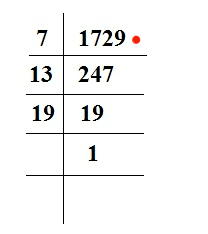
These three (3) number are twin primes. We called the pairs as True Prime Pairs. Our scenario is mapping the distribution out of these pairs by taking the symmetrical behaviour of 36 as the smallest power (greater than 1) which is not a prime power.
It is the sum of the fourth pair of twin-primes (17 + 19) (Wikipedia!).
$True Prime Pairs:
 (5,7), (11,13), (17,19)

 layer|  i  |   f
 -----+-----+---------
      |  1  | 5
   1  +-----+
      |  2  | 7
 -----+-----+---  } 36 » 6®
      |  3  | 11
   2  +-----+
      |  4  | 13
 -----+-----+---------
      |  5  | 17
   3  +-----+     } 36 » 6®
      |  6  | 19
 -----+-----+---------
Thus, in short, this is principally all about a method that we called as the 19 vs 18 Scenario of mapping the quantum way within a huge of primes objects (5 to 19) by lexering (11) the ungrammared feed (7) and parsering (13) across syntax (17).
The number 36 is a composite. Here are some of the other points taken from (Prime Curios!).
- The exact number of ways to partition the integer 36 is prime.
- The smallest number which is the sum of two distinct odd primes in four ways (36 = 5 + 31 = 7 + 29 = 13 + 23 = 17 + 19). [McCranie]
- The smallest square that is the sum of a twin prime pair {17, 19}. [Trotter]
- The smallest number expressible as the sum of consecutive primes in two ways (5 + 7 + 11 + 13 and 17 + 19). [De Geest]
- 5+7+11+13 is the smallest square number expressible as the sum of four consecutive primes which are also two couples of prime twins! [Herault]
Φ(1,2,3) = Φ(6,12,18) = Φ(13,37,61)
$True Prime Pairs:
(5,7), (11,13), (17,19)

layer | node | sub |  i  |  f
------+------+-----+----------
      |      |     |  1  |
      |      |  1  +-----+
      |  1   |     |  2  | (5)
      |      |-----+-----+
      |      |     |  3  |
  1   +------+  2  +-----+----
      |      |     |  4  |
      |      +-----+-----+
      |  2   |     |  5  | (7)
      |      |  3  +-----+
      |      |     |  6  |
------+------+-----+-----+------      } (36) ✓
      |      |     |  7  |
      |      |  4  +-----+
      |  3   |     |  8  | (11)
      |      +-----+-----+
      |      |     |  9  |
  2   +------|  5  +-----+-----
      |      |     |  10 |
      |      |-----+-----+
      |  4   |     |  11 | (13)
      |      |  6  +-----+
      |      |     |  12 |
------+------+-----+-----+------------------
      |      |     |  13 |
      |      |  7  +-----+
      |  5   |     |  14 | (17)
      |      |-----+-----+
      |      |     |  15 |
  3   +------+  8  +-----+-----       } (36) ✓
      |      |     |  16 |
      |      |-----+-----+
      |  6   |     |  17 | (19)
      |      |  9  +-----+
      |      |     |  18 |
------|------|-----+-----+------
You may notice that there are twists and turns until 19 abuts 2 therefore this addition zone takes only the seven (7) primes out of the 18's structure of True Prime Pairs.
There are 7 hidden dimensions in 11-d Supergravity, which is the low energy approximation to M theory, which also has 7 hidden dimensions. (Prime Curios!)
$True Prime Pairs:
(5,7), (11,13), (17,19)

layer | node | sub |  i  |  f
------+------+-----+----------
      |      |     |  1  | --------------------------
      |      |  1  +-----+                           |
      |  1   |     |  2  | (5)                       |
      |      |-----+-----+                           |
      |      |     |  3  |                           |
  1   +------+  2  +-----+----                       |
      |      |     |  4  |                           |
      |      +-----+-----+                           |
      |  2   |     |  5  | (7)                       |
      |      |  3  +-----+                           |
      |      |     |  6  |                          11s ✓
------+------+-----+-----+------      } (36)         |
      |      |     |  7  |                           |
      |      |  4  +-----+                           |
      |  3   |     |  8  | (11)                      |
      |      +-----+-----+                           |
      |      |     |  9  |                           |
  2   +------|  5  +-----+-----                      |
      |      |     |  10 |                           |
      |      |-----+-----+                           |
      |  4   |     |  11 | (13) ---------------------
      |      |  6  +-----+
      |      |     |  12 |---------------------------
------+------+-----+-----+------------               |
      |      |     |  13 |                           |
      |      |  7  +-----+                           |
      |  5   |     |  14 | (17)                      |
      |      |-----+-----+                           |
      |      |     |  15 |                           7s √
  3   +------+  8  +-----+-----       } (36)         |
      |      |     |  16 |                           |
      |      |-----+-----+                           |
      |  6   |     |  17 | (19)                      |
      |      |  9  +-----+                           |
      |      |     |  18 | --------------------------
------|------|-----+-----+------
The tessellating field of equilateral triangles fills with numbers, with spin orientation flipping with each prime number encountered, creating 3 minor hexagons.
Prime numbers are numbers that have only 2 factors: 1 and themselves.
- For example, the first 5 prime numbers are 2, 3, 5, 7, and 11. By contrast, numbers with more than 2 factors are call composite numbers.
- 1 is not a prime number because it can not be divided by any other integer except for 1 and itself. The only factor of 1 is 1.
- On the other hand, 1 is also not a composite number because it can not be divided by any other integer except for 1 and itself.
In conclusion, the number 1 is neither prime nor composite.
π(6+11) = π(17) = 7

So the most important thing that need to be investigated is why the prime spinned by module six (6). What is the special thing about this number six (6) in primes behaviour?
Similarly, I have a six colored dice in the form of the hexagon. If I take a known, logical sequence of numbers, say 10, 100, 1000, 10000, and look at their spins in the hexagon, the resulting colors associated with each number should appear random – unless the sequence I’m investigating is linked to the nature of the prime numbers.
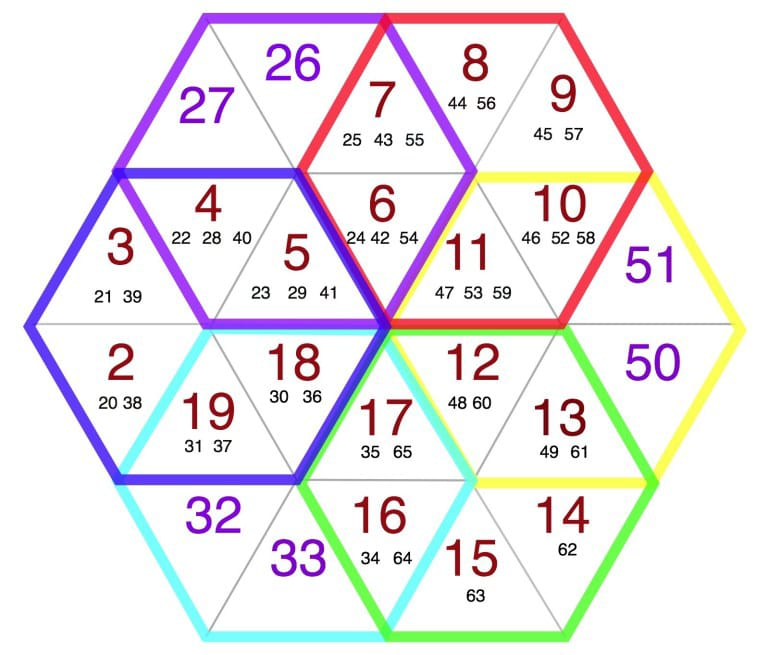
So there would be the empty spaces for 18 - 7 = 11 numbers. By our project these spaces will be unified by all of the eleven (11) members of identition zones.
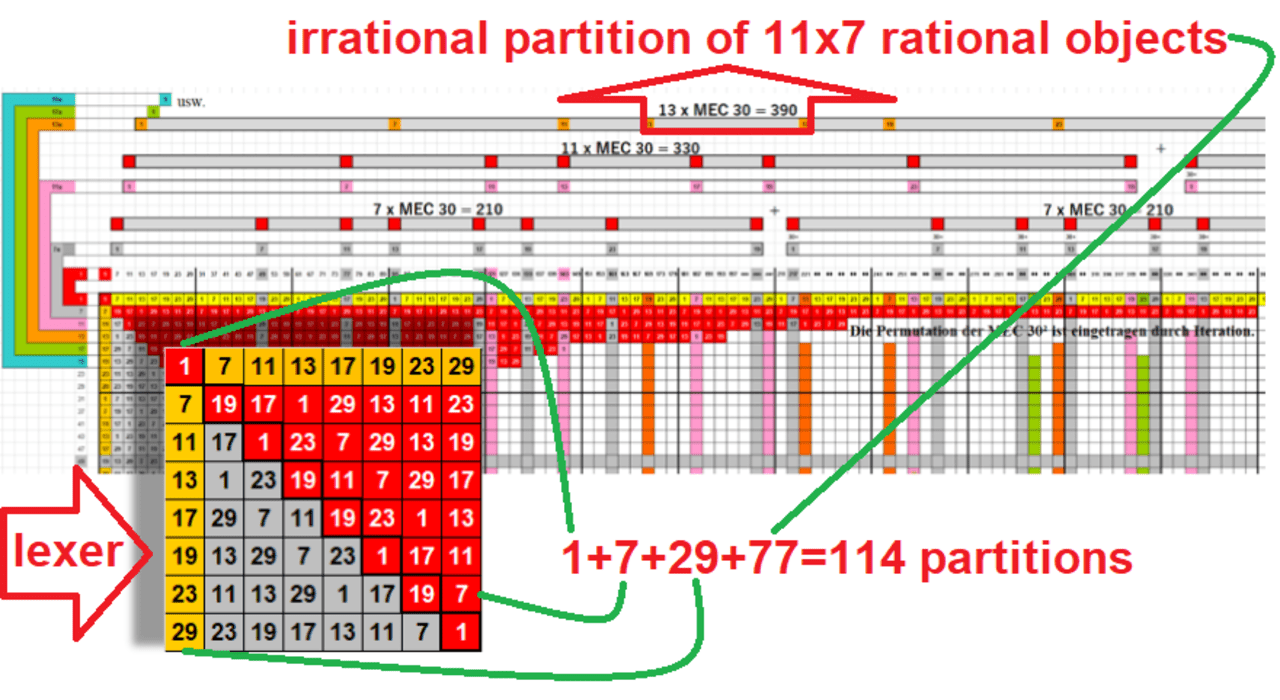
By the multiplication zones onwards we will discuss how this reversal behaviour is converting the 11 dimensions to 7 x 11 = 77 partitions.
(11x7) + (29+11) + (25+6) + (11+7) + (4+1) = 77+40+31+18+5 = 171
This path is being applied as you can find on the left sidebar. (Please change the view to desktop mode if you are on mobile browser).
Multiplication Zones
As you may aware, the prime number theorem describes the asymptotic distribution of prime numbers which is still a major problem in mathematic.
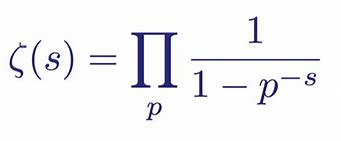
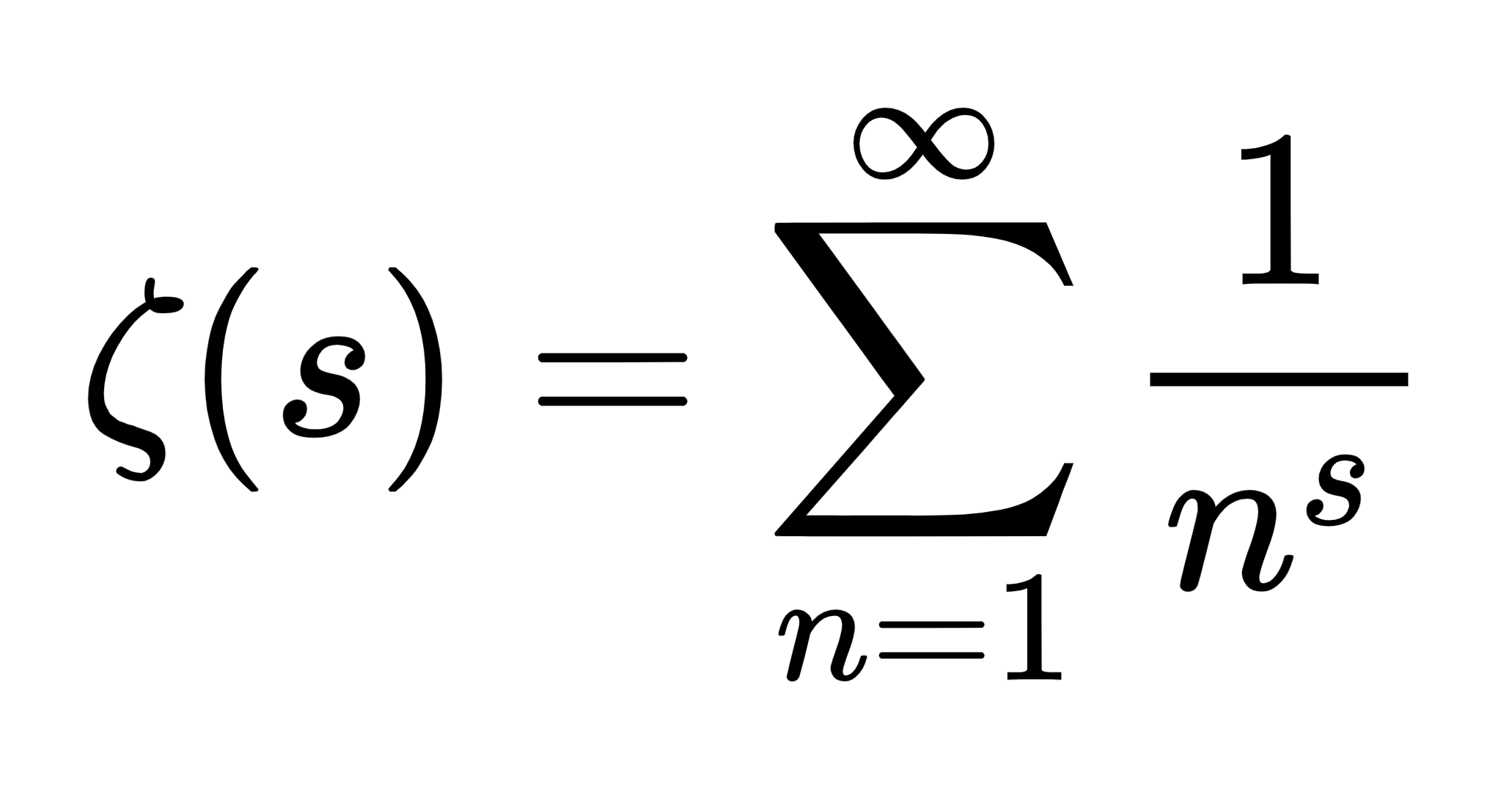
Instead of a proved formula we came to an expression called zeta function that first appeared in a paper in 1737 entitled Variae observationes circa series infinitas. This expression states that the sum of the zeta function is equal to the product of the reciprocal of one minus the reciprocal of primes to the powers. But what has this got to do with the primes? The answer is in the following product taken over the primes p (discovered by Leonhard Euler):
This issue is actually come from Riemann hypothesis, a conjecture about the distribution of complex zeros of the Riemann zeta function that is considered to be the most important of unsolved problems in pure mathematics.
In addition to the trivial roots, there also exist complex roots for real t. We find that the he first ten (10) non-trivial roots of the Riemann zeta function is occured when the values of t below 50. A plot of the values of ζ(1/2 + it) for t ranging from –50 to +50 is shown below. The roots occur each time the locus passes through the origin. (mathpages).
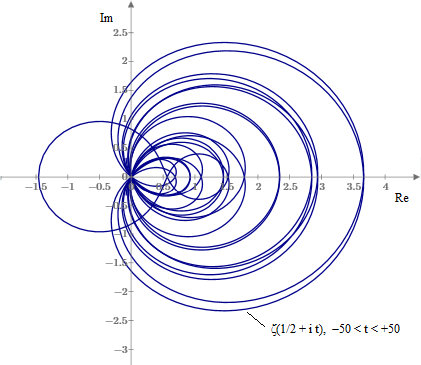
The Riemann zeta function provides a way to give an exact formula for π(x) by summing over the non-trivial zeros of the zeta function.
Meanwhile obtaining the non complex numbers it is easier to look at a graph like the one below which shows Li(x) (blue), R(x) (black), π(x) (red) and x/ln x (green); and then proclaim “R(x) is the best estimate of π(x).” Indeed it is for that range, but as we mentioned above, Li(x)-π(x) changes sign infinitely often, and near where it does, Li(x) would be the best value.
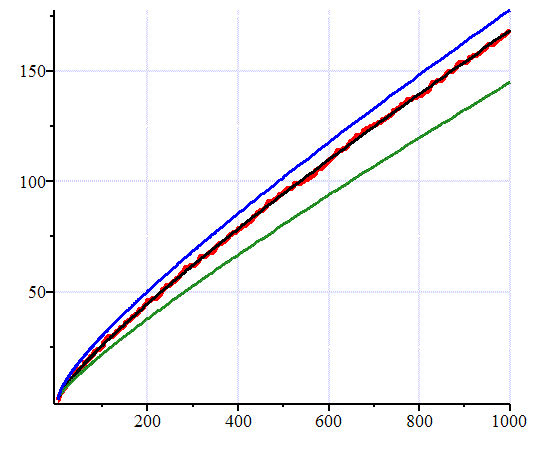
And we can see in the same way that the function Li(x)-(1/2)Li(x1/2) is ‘on the average' a better approximation than Li(x) to π(x); but no importance can be attached to the latter terms in Riemann's formula even by repeated averaging.
The problem is that the contributions from the non-trivial zeros at times swamps that of any but the main terms in these expansions.
A. E. Ingham says it this way: Considerable importance was attached formerly to a function suggested by Riemann as an approximation to π(x)… This function represents π(x) with astonishing accuracy for all values of x for which π(x) has been calculated, but we now see that its superiority over Li(x) is illusory… and for special values of x (as large as we please) the one approximation will deviate as widely as the other from the true value (primes.utm.edu).
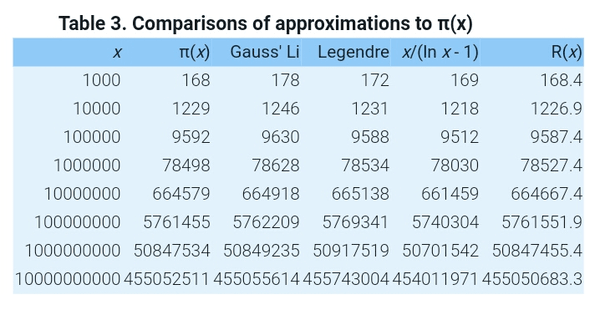
Moreover in it was verified numerically, in a rigorous way using interval arithmetic, that The Riemann hypothesis is true up to 3 · 10^12. That is, all zeroes β+iγ of the Riemann zeta-function with 0<γ≤3⋅1012 have β=1/2.
We have Λ ≤ 0.2. The next entry is conditional on taking H a little higher than 10*13, which of course, is not achieved by Theorem 1. This would enable one to prove Λ < 0.19. Given that our value of H falls between the entries in this table, it is possible that some extra decimals could be wrought out of the calculation. We have not pursued this (arXiv:2004.09765).
This Euler formula represents the distribution of a group of numbers that are positioned at regular intervals on a straight line to each other.
Riemann later extended the definition of zeta(s) to all complex numbers (except the simple pole at s=1 with residue one).
- Euler’s product still holds if the real part of s is greater than one.
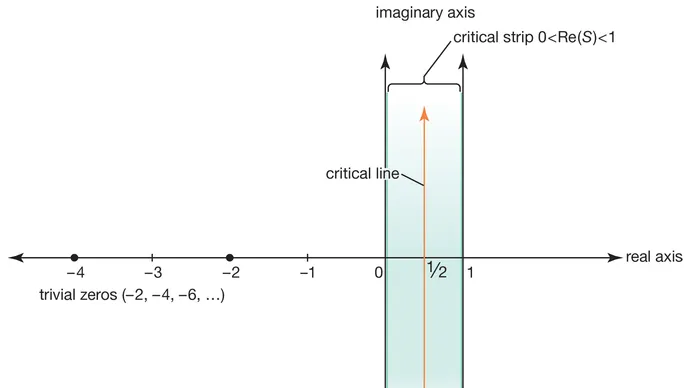
- Riemann derived the functional equation of zeta function. This Riemann zeta function has the trivial zeros at -2, -4, -6, … (the poles of gamma(s/2)).
- Using the Euler product (with the functional equation) it is easy to show that all the other zeros are in the critical strip of non-real complex numbers with 0 < Re(s) < 1, and that they are symmetric about the critical line Re(s)=1/2.
The unproved Riemann hypothesis is that all of the nontrivial zeros are actually on the critical line (primes.utm.edu).
If both of the above statements are true then mathematically this Riemann Hypothesis is proven to be incorrect because it only applies to certain cases or limitations. So first of all the basis of the Riemann Hypothesis has to be considered.
The solution is not only to prove Re(z)= 1/2 but also to calculate ways for the imaginary part of the complex root of ζ(z)=0 and also to solve the functional equations. (Riemann Zeta - pdf)
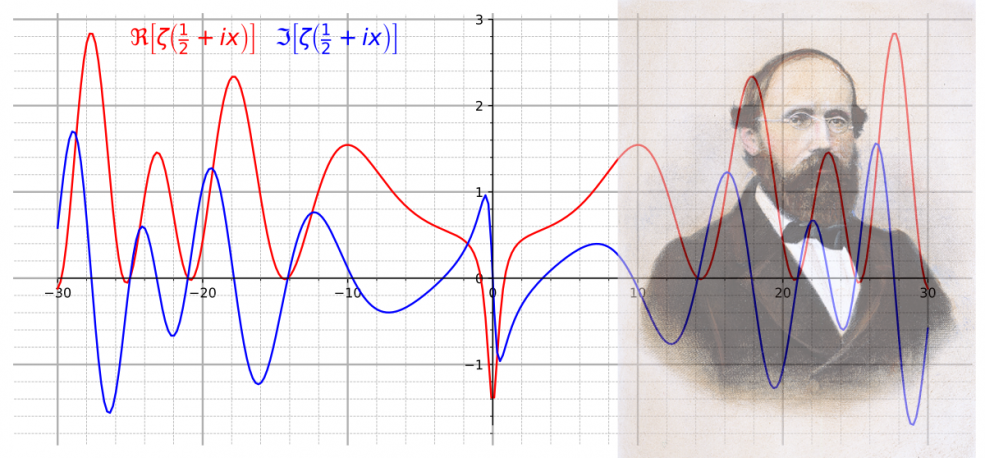
On the other hand, the possibility of obtaining the function of the distribution of prime numbers shall go backwards since it needs significant studies to be traced.
Or may be start again from the Euler Function.
Freeman Dyson discovered an intriguing connection between quantum physics and Montgomery’s pair correlation conjecture about the zeros of the zeta function which dealts with the distribution of primes.
The Mathematical Elementary Cell 30 (MEC30) standard unites the mathematical and physical results of 1972 by the mathematician Hugh Montgomery and the physicist Freeman Dyson and thus reproduces energy distribution in systems as a path plan more accurately than a measurement. (Google Patent DE102011101032A9)
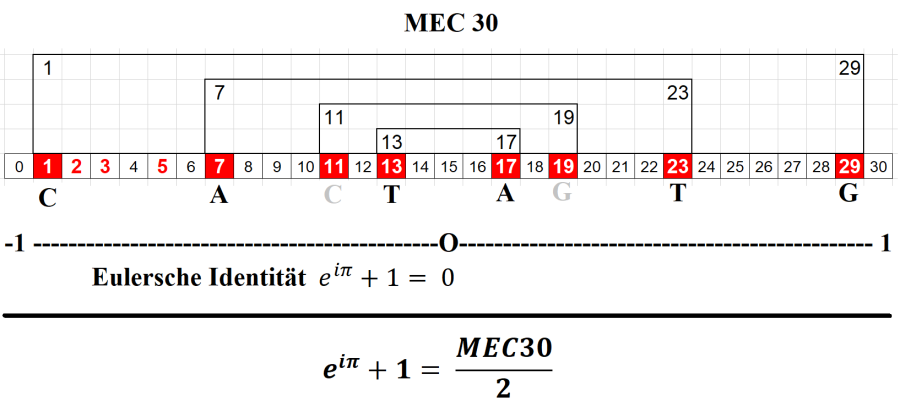
The path plan assume that a symmetric distribution of prime numbers with equal axial lengths from a middle zero axis = 15 is able to determine the distribution of primes in a given number space. This assumption finally bring us to the equation of Euler's identity.
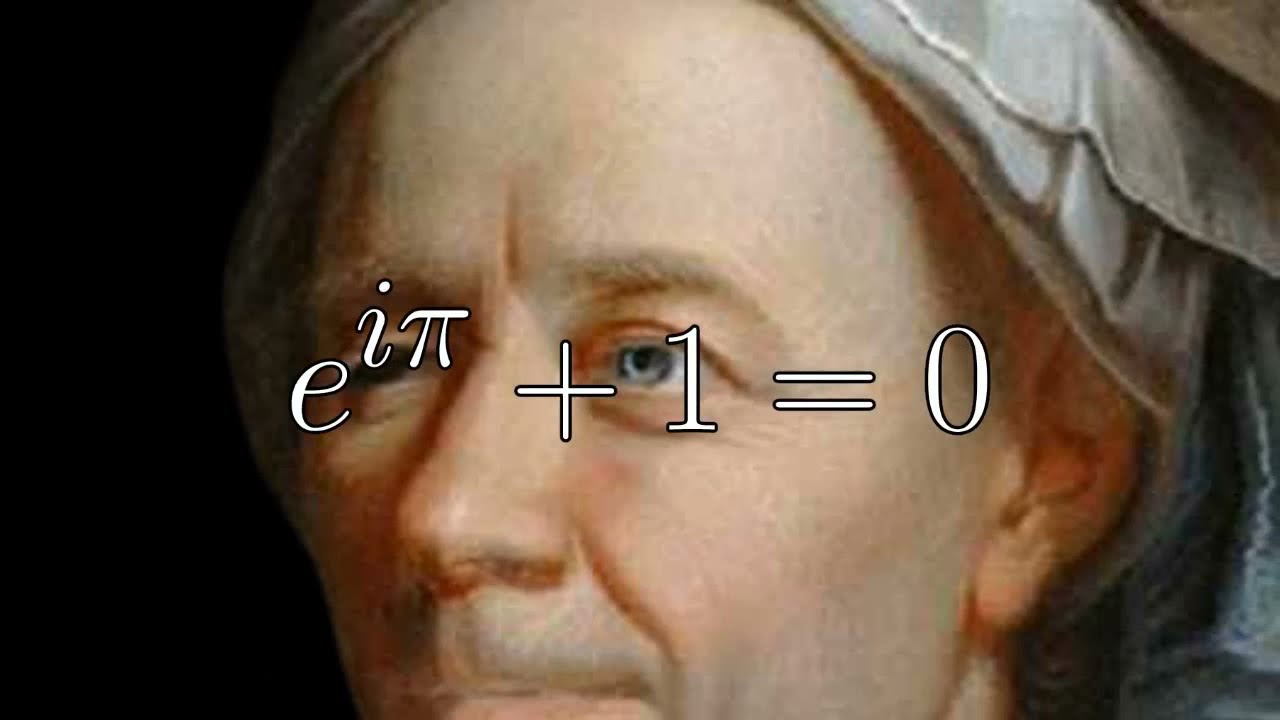
Euler’s identity is considered to be an exemplar of deep mathematical beauty as it shows a profound connection between the most fundamental numbers. Three (3) of the basic arithmetic operations occur exactly once each: addition, multiplication, and exponentiation (Wikipedia).
By The Δ(19 vs 18) Scenario those three are exactly landed in the 0's cell out of Δ18. See that the sum of 30 and 36 is 66 while the difference between 36 and 102 is also 66.
You likely noticed I began with 2 rather than 1 or 0 when I first constructed the hexagon. Why? Because they do not fit inside — they stick off the hexagon like a tail. Perhaps that’s where they belong. However, if one makes a significant and interesting assumption, then 1 and 0 fall in their logical locations – in the 1 and 0 cells, respectively. _(HexSpin)
0 + 30 + 36 + 102 = 168 = π(1000)
Therefore the total files that inherited from this scheme will be 1 + 7 + 29 = 37 files including one (1) main page. Where the 6 x 6 = 36 should behave as a central.
The finiteness position of Euler’s identity by the said MEC30 opens up the possibility of accurately representing the self-similarity based on the distribution of True Prime Pairs so that all number would belongs together with their own identitities.
102 + 7 = 109 = 29th prime = (10th prime)th prime
By our project, these 37 files are located within the wiki of main repository and organized by the 18's structure located per the 18 files of project gist.
Exponentiation Zones
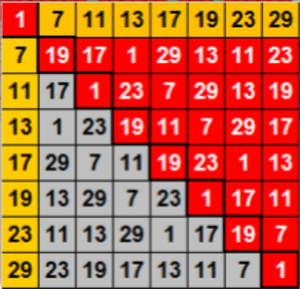
The cyclic behaviors of MEC30 are represented by the pure numerical of the 8 × 8 square product positions that sets continues infinitely.
In this one system, represented as an icon, we can see the distribution profile of the prime numbersas well as their products via a chessboard-like model in Fig. 4. This fundamental chewing
- We show the connection in the MEC 30 mathematically and precisely in the table Fig. 13. The organization of this table is based on the well-known idea of Christian Goldbach.
- That every even number from the should be the sum of two prime numbers. From now on we call all pairs of prime numbers without “1”, 2, 3, 5 Goldbach couples.
The MEC 30 transforms this idea from Christian Goldbach into the structure of a numerical double strand, into an opposite link of the MEC 30 scale. (MEC 30 - pdf)
There are more than one version of Standard Model (SM) being developed. Here we are referring to the 19 Free Parameters that is match to the behaviour of MEC30.
The SM was basically developed in 1970-s. It describes the electromagnetic, weak and strong fundamental interactions.
- At ordinary energies (a few eV or less), the forces differ greatly. However, at energies available in accelerators, the weak nuclear and electromagnetic (EM) forces become unified. Unfortunately, the energies at which the strong nuclear and electroweak forces become the same are unreachable.
- The relative strengths of the four basic forces vary with distance, and, hence, energy is needed to probe small distances.

- The (3) layers represents generation in the particle objects of flavor that counts six (6) flavours of quarks and six (6) flavours of leptons.
- The newly discovered Higgs Boson interacts with all the Quarks and the first group of Leptons (electron, muon and tau) providing them with their mass. The neutrinos which are the other Leptons originally were thought to have zero mass, but recent discoveries argue that this is not the case.

The Weak bosons interact with both Leptons and Quarks, these are responsible for the Weak nuclear forces. The exchange of photon is responsible for the Electromagnetic Force.
Rearrangement of StandardModel originally developed by Bin Wu from CERN
| 6 QUARKS | no | 6 LEPTONS | no | 7 BOSONS (GAUGE AND HIGGS) | no |
|---|---|---|---|---|---|
| d: Down | 19 | \(e^-\): electron | 13 | \(γ\): photon | 7 |
| u: Up | 18 | \(ν_e\): \(e\) neutrino | 12 | \(g\): gluons | 5(6) |
| s: Strange | 17 | \(μ^-\): muon | 11 | \(H^0\): Higgs boson | 4 |
| c: Charm | 16 | \(ν_μ\): \(μ\) neutrino | 10 | \(W^+\): positively charged weak boson | 3 |
| b: Bottom | 15 | \(τ^-\): tau | 9 | \(W^-\): negatively charged weak boson | 2 |
| t: Top | 14 | \(ν_τ\): \(τ\) neutrino | 8 | \(Z^0\): neutral weak boson | 1 |
This results in a fundamental causal relation to the primes, systemically the products are entered into the position system.
In this one system, reproduced as an icon, we can show the distribution profile of the primes as well as their products over a checkerboard-like model in the 4.
- We show this fundamental causal relationship in the MEC 30 mathematically accurate in the table 13 , The organization of this table is based on the well-known idea of Christian Goldbach. That every even number should consist of the sum of two primes.
- All pairs of prime numbers without “1”, 2, 3, 5, we call henceforth Goldbach pairs. The MEC 30 transforms this idea of Christian Goldbach into the structure of a numerical double-strand, into an opposing member of the MEC 30 scale.
- We call this double strand a convolution, which results in an opposite arrangement. It represents the natural vibration, thus also the redundant vibrations in the energy transfer. In the 6 For example, in the graph, the even number 60 is folded. At folding of the even number 60 6 result in 8 prime pairs.
- In this case, among the 8 pairs of prime pairs there are only 6 Goldbach pairs. 2 prime positions in the prime position pairs carry products of the factors “1 × 1” and 7 × 7. Thus, 2 prime pairs do not fulfill the requirements of the Goldbach pairs. In general, any even number larger than 30 can be represented graphically within a cycle (MEC 30) as a specific cyclic convolution. This characteristic convolution of the even numbers is a fundamental test element in the numerical table. The result Even the even numbers to infinity occupy a fixed position within the 30s system MEC 30. The even numbers thus have 15 positions: 30/2 = 15 even positions of the MEC 30.
- There are therefore only 15 even positions for all even numbers to infinity. Every even number has a specific convolution due to its position in the 30s system. First, we have to determine the positions of the even numbers in the 30s system to make them one in the following graph 7 attributable to the 15 specific folds.

This scheme goes to the unification of 11s with 7s to 18s meanwhile the 11th it self behave as residual by the 5th minor hexagon between the 30 to 36' cells.
An overview of the various families of elementary and composite particles, and their interactions. Fermions are on the left, and Bosons are on the right.
According to the Standard Model there are five (5) elementary bosons with thirteen (13) variations. These 5 and 13 will be assigned to the “5xid’s of 31~35 (sequenced)” and “13xid’s of 36~68 (unsequenced)”, respectively (see the sidebar menu).
- One (1) scalar boson (spin = 0) Higgs boson – the particle that contributes to the phenomenon of mass via the Higgs mechanism (assigned to “19xid’s of 2~30”).
- Four (4) vector bosons (spin = 1) that act as force carriers. These four are the gauge bosons, they have twelve (12) different types originated from the interaction on bispinor-2 and -3 to the twelve (12) spinors of majorana:
- γ Photon – the force carrier of the electromagnetic field (id:31).
- g Gluons (eight (8) different types) – force carriers originated from the eight (8) spinors of bispinor-1 to -4 that mediate the strong force (id:33)
- Z Neutral weak boson – the force carrier that mediates the weak force and
- W± Charged weak bosons (two (2) types) – force carriers that mediate the weak force (id:34).
- A second order tensor boson (spin = 2) called the graviton (G). It has been hypothesised as the force carrier for gravity (id:32).
36th prime - 30th prime = 151 - 113 = 1 + 37

The boson, photon and gravity forces are assigned to 30, 31 and 32. Gluon force and exchange are assigned to 33 and 34 which are then standing as the lexer and parser.
There are 8 different types of tiny particles, or ‘states’, that we can find in a special kind of space that has 6 dimensions and involves both real and imaginary numbers. These particles include:
- The Higgs field, which doesn’t spin and is represented by 0.
- Fermions, which are particles like electrons, having a spin of plus or minus a half.
- Bosons, like photons, which have a spin of plus or minus 1.
- Anti-fermions, which are like fermions but have a spin of plus or minus two-thirds.
- The graviton, believed to be responsible for gravity, with a spin of 2.
In a diagram at the top left, this 6-dimensional space is shown to be curved. In another diagram at the bottom right, we see two waves that are perpendicular to each other, representing the motion of a particle in a ‘Dirac harmonic oscillator’ – a concept in quantum mechanics. (Physics In History)
19 + 18 + 102 = 37 + 102 = 139 = 34th prime = (40 - 6)the prime
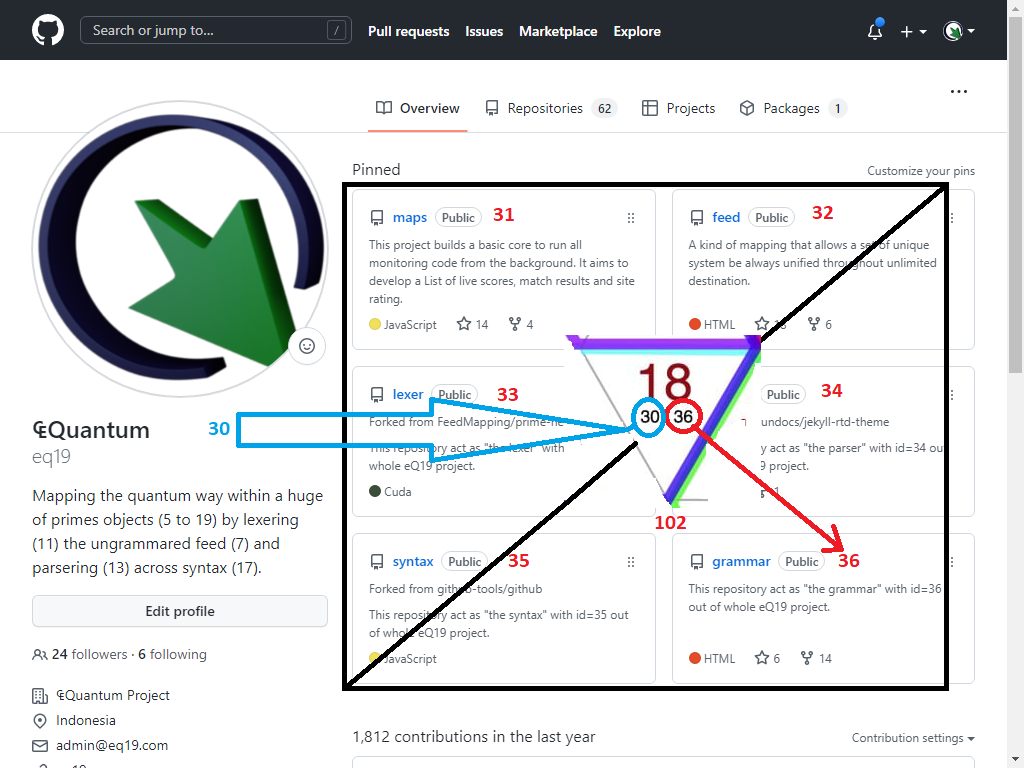
This lead to a consequence of SU(5) grand unification (assigned to 35) showing a complex scalar Higgs boson of 24 gauge groups observe mass of W boson (assigned to 36).
The eight (8) steps between id:30 to 37 represents the Eightfold Way in the context of E8 Theory, a pattern developing in physics to represent the fundamental particles.
- E8 is at the heart of many bits of physics. One interpretation of why we have such a quirky list of fundamental particles is because they all result from different facets of the symmetries of E8.
- The enigmatic E8 is the largest and most complicated of the five exceptional Lie groups, and contains four subgroups that are related to the four fundamental forces of nature: the electromagnetic force; the strong force (which binds quarks); the weak force (which controls radioactive decay); and the gravitational force.
Even if i turns out to be wrong, the E8 theory he has pioneered showcases striking patterns in particle physics that any unified theory will need to explain. (Wordpress)

This behaviour finaly brings us to a suggestion that the spin in the prime hexagon are linked with the prime distribution level as indicated by the self repetition on MEC30.
By our project the spin will be generated from 18’s on the gist so it will cover five (5) unique functions that behave as one (1) central plus four (4) zones.
- This scheme will be implemented to all of the 168 repositories as bilateral way (in-out) depend on their postion on the system. So along with the gist it self then there shall be
1 + 168 = 169units of 1685 root functions. Each of functions has their own model. Those models will be organized per IREE’s plan below: - IREE (Intermediate Representation Execution Environment) is an MLIR-based end-to-end compiler and runtime that lowers Machine Learning (ML) models to a unified IR that scales up to meet the needs of the datacenter and down to satisfy the constraints and special considerations of mobile and edge deployments.
From what we learned above about segregating spin candidates, we can demonstrate that they compile additively in perfect progression, completing an infinite sequence of circles (multiples of 30 and 360) which is inline with the behaviour of MEC30.
5 + 2 x 5 x 168 = 5 + 1680 = 1685 root functions
The thirt, equivalent to one rotation around the Prime Spiral Sieve is like a mile marker on the prime number highway.
A thirt, in case you’re wondering, is a useful unit of measure when discussing intervals in natural numbers not divisible by 2, 3 or 5.
- Another fascinating feature of this array is that any even number of–not necessarily contiguous–factors drawn from any one of the 32 angles in this modulo 120 configuration distribute products to 1(mod 120) or 49 (mod 120), along with the squares.
- We see from the graphic above that the digital roots of the Fibonacci numbers indexed to our domain (Numbers ≌ to {1,7,11,13,17,19,23,29} modulo 30) repeat palindromically every 32 digits (or 4 thirts) consisting of 16 pairs of bilateral 9 sums.
- The digital root sequence of our domain, on the other hand, repeats every 24 digits (or 3 thirts) and possesses 12 pairs of bilateral 9 sums. The entire Prime Root sequence end-to-end covering 360° has 48 pairs of bilateral 9 sums.
- And finally, the Prime Root elements themselves within the Cirque, consisting of 96 elements, has 48 pairs of bilateral sums totaling 360. Essentially, the prime number highway consists of infinitely telescoping circles …
- Also note, the digital roots of the Prime Root Set as well as the digital roots of Fibonnaci numbers and Lucas numbers (the latter not shown above) indexed to it all sum to 432 (48x9) in 360° cycles.
- The sequence involving Fibonacci digital roots repeats every 120°, and has been documented by the author on the On-Line Encyclopedia of Integer Sequences: Digital root of Fibonacci numbers indexed by natural numbers not divisible by 2, 3 or 5 (A227896).
- The four faces of our pyramid additively cascade 32 four-times triangular numbers (Note that 4 x 32 = 128 = the perimeter of the square base which has an area of 32^2 = 1024 = 2^10).
- These include Fibo1-3 equivalent 112 (rooted in T7 = 28; 28 x 4 = 112), which creates a pyramidion or capstone in our model, and 2112 (rooted in T32 = 528; 528 x 4 = 2112), which is the index number of the 1000th prime within our domain, and equals the total number of ‘elements’ used to construct the pyramid.
If we take the Modulo 30 Prime Spiral Sieve and expand it to Modulo 360, we see that there are 12 thirts in one complete circle, or ‘cirque’ as we’ve dubbed it. Each thirt consists of 8 elements. (PrimesDemystified)
7th spin - 4th spin = (168 - 102)s = 66s = 6 x 11s = 30s + 36s
During this interchange, the two 16-plets will be crossing over and farther apart but they are more likely to stick together and not switch places.
Identition Zones
By our project the rotation as above is iterated back into Additional Zones. This process brings the concept of higher dimensions that lead into successive Golden ratio.
The Klein bottle is in someways a 3D version of the Mobius strip. Even though it exists in 3 dimensions, to make a true one you need to “fold through” the 4th dimension. Suppose for clarification that we adopt time as that fourth dimension.
$True Prime Pairs:
(5,7), (11,13), (17,19)

layer | node | sub |  i  |  f
------+------+-----+----------           ✓
      |      |     |  1  | ----------‹ 289® ‹--------
      |      |  1  +-----+                           |
      |  1   |     |  2  | (5)                       |
      |      |-----+-----+                           |
      |      |     |  3  |                           |
  1   +------+  2  +-----+----                       |
      |      |     |  4  |                           |
      |      +-----+-----+                           |
      |  2   |     |  5  | (7)                       |
      |      |  3  +-----+                           |
      |      |     |  6  |                          11s
------+------+-----+-----+------      } (36)         |
      |      |     |  7  |                           |
      |      |  4  +-----+                           |
      |  3   |     |  8  | (11)                      |
      |      +-----+-----+                           |
      |      |     |  9  |                           |
  2   +------|  5  +-----+-----                      |
      |      |     |  10 |                           |
      |      |-----+-----+               ✓           |
      |  4   |     |  11 | (13) -----› 329® ›---------
      |      |  6  +-----+               ✓
      |      |     |  12 |-----------‹ 169® ‹--------
------+------+-----+-----+------------               |
      |      |     |  13 |                           |
      |      |  7  +-----+                           |
      |  5   |     |  14 | (17)                      |
      |      |-----+-----+                           |
      |      |     |  15 |                           7s
  3   +------+  8  +-----+-----       } (36)         |
      |      |     |  16 |                           |
      |      |-----+-----+                           |
      |  6   |     |  17 | (19)                      |
      |      |  9  +-----+               ✓           |
      |      |     |  18 | ----------› 359® ›--------
------|------|-----+-----+------
The Golden Ratio "symbolically links each new generation to its ancestors, preserving the continuity of relationship as the means for retracing its lineage."
There is a fascinating connection between prime numbers and the Golden ratio.
- The Golden ratio is an irrational number, which means that it cannot be expressed as a ratio of two integers. However, it can be approximated by dividing consecutive Fibonacci numbers.
- Additionally, it has been observed that the frequency of prime numbers in certain sequences related to the Golden ratio (such as the continued fraction expansion of the Golden ratio) appears to be higher than in other sequences.
- Interestingly, the Fibonacci sequence is closely related to prime numbers, as any two consecutive Fibonacci numbers are always coprime.
However, the exact nature of the relationship between primes and the Golden ratio is still an active area of research.
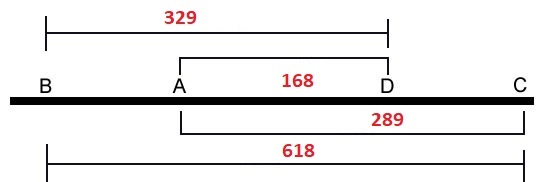
π(Φ x (329 + 289)) = π(Φ x 618) = π(1000) = 168 = 169 - 1
The mathematically significant Fibonacci sequence defines a set of ratios which can be used to determine probable entry and exit points.
Simply stated, the Golden Ratio establishes that the small is to the large as the large is to the whole. This is usually applied to proportions between segments.
- In the special case of a unit segment, the Golden Ratio provides the only way to divide unity in two parts that are in a geometric progression:
- The side of a pentagon-pentagram can clearly be seen as in relation to its diagonal as 1: (√5 +1)/2 or 1:φ, the Golden Section:
- When you draw all the diagonals in the pentagon you end up with the pentagram. The pentagram shows that the Golden Gnomon, and therefore Golden Ratio, are iteratively contained inside the pentagon:
- There are set of sequence known as Fibonacci retracement. For unknown reasons, these Fibonacci ratios seem to play a role in the stock market, just as they do in nature. The Fibonacci retracement levels are 0.236, 0.382, 0.618, and 0.786.

- The key Fibonacci ratio of 61.8% is found by dividing one number in the series by the number that follows it. For example, 21 divided by 34 equals 0.6176, and 55 divided by 89 equals about 0.61798.
- The 38.2% ratio is discovered by dividing a number in the series by the number located two spots to the right. For instance, 55 divided by 144 equals approximately 0.38194.
- The 23.6% ratio is found by dividing one number in the series by the number that is three places to the right. For example, 8 divided by 34 equals about 0.23529.
- The 78.6% level is given by the square root of 61.8%
- While not officially a Fibonacci ratio, 0.5 is also commonly referenced (50% is derived not from the Fibonacci sequence but rather from the idea that on average stocks retrace half their earlier movements).
This study cascade culminating in the Fibonacci digital root sequence (also period-24). (Golden Ratio - Articles)
(√0.618 - 0.618) x 1000 = (0.786 - 0.618) x 1000 = 0.168 x 1000 = 168 = π(1000)
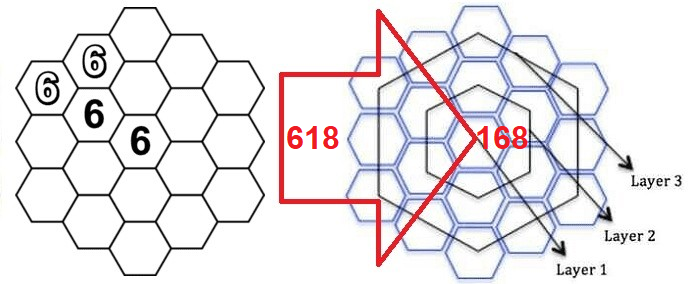
Within these 1000 primes there will be fractions which end up with 168 identities. This will be the same structure as the seven (7) pàrtitions of addition zones.
The first 1000 prime numbers are silently screaming: “Pay attention to us, for we hold the secret to the distribution of all primes!” We heard the call, and with ‘strange coincidences’ leading the way have discovered compelling evidence that the 1000th prime number, 7919, is the perfectly positioned cornerstone of a mathematical object with highly organized substructures and stunning reflectional symmetries. (PrimesDemystified)
1st layer (addition):
It has a total of 1000 numbers
Total primes = π(1000) = 168 primes

2nd layer (multiplication):
It will start by π(168)+1 as the 40th prime
It has 100x100 numbers or π(π(10000)) = 201 primes
Total cum primes = 168 + (201-40) = 168+161 = 329 primes

3rd layer (conduct exponentially):
Behave reversal to 2nd layer which has a total of 329 primes
The primes will start by π(π(π(1000th prime)))+1 as the 40th prime
This 1000 primes will become 1000 numbers by 1st layer of the next level
Total of all primes = 329 + (329-40) = 329+289 = 618 = 619-1 = 619 primes - Δ1
So when we trace back with Exponential Zones, the 618 and 168 perform themselves as composite particles and forces that are generated recursively.
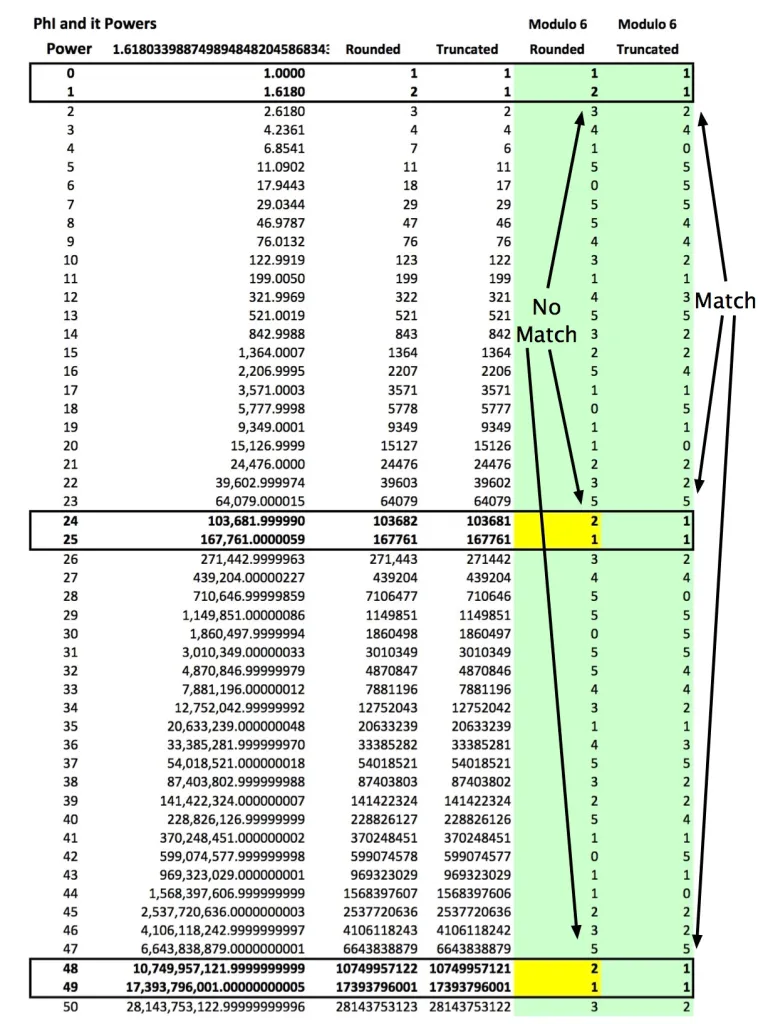
I wondered if that property might hold for the incremental powers of phi as well. For this reason I chose to see numbers in the hexagon as quantum, and truncate off the decimal values to determine which integer cell they land in. That is what I found. Phi and its members have a pisano period if the resulting fractional numbers are truncated. (Prime Hexagon).
The above scheme is also applied in to our project sections which is consists of four (4) zones, the 1st- layer covers addition and multiplication zones, the rest are single zones.
The (3) layers represents generation in the Standard Model of flavor that counts six (6) flavours of quarks and six (6) flavours of leptons.

In the special case of a unit segment, the Golden Ratio provides the only way to divide unity in two parts that are in a geometric progression
One of the most promising attempts to go beyond the standard model of particle physics is superstring theory.
- As it is well known, special relativity fused time and space together, then came general relativity and introduced a curvature to space-time.
- Kaluza and later on Klein added one more dimension to the classical four in order to unify general relativity and electromagnetism.
The dimensionality of space-time plays a paramount role in the theoretical physics of unification and has led to the introduction of the 26 dimensions of string theory, the 10 dimensions of superstring theory, and finally the heterotic string theory with the dimensional hierarchy 4, 6, 10, 16 and 26
We apply this progression to the rest of the space, and find that the breakdown of the three (3) generations are fit into our four (4) zones as we have discussed.
New findings are fueling an old suspicion that fundamental particles and forces spring from strange eight-part numbers called “octonions.”
There are 30 canonical sets of 7 triads indexed with a Fano plane index (fpi). In order to make a valid octonion, each fpi gets one of 8 possible 7-bit sign masks (sm).
The electroweak force is believed to have separated into the electromagnetic and weak forces during the quark epoch of the early universe.
In both cases, the masses of the W± and Z bosons would be affected, potentially leading to different physics and potentially affecting the stability and creation.
Perhaps more importantly, each of the four forces refers to particular operational aspects of particle assemblies. We will discuss it in detail on the further sections.
π(1000) - loop(1,30) - loop(31,36) = 168 - 29 - 25 = 114 = π(1 + 618)
Nothing is going to be easly about the nature of prime numbers but they demonstrably congruent to something organized. Let's discuss starting with the addition zones.
eQuantum Project
Copyright © 2023-2026
References:
