Addition Zones (0-18)
Addition is the form of an expression set equal to zero as the additive identity which is common practice in several areas of mathematics.
This section is referring to wiki page-1 of zone section-1 that is inherited from the zone section-1 by prime spin-1 and span- with the partitions as below.
- True Prime Pairs
- Primes Platform
- Pairwise Scenario
- Power of Magnitude
- The Pairwise Disjoint
- The Prime Recycling ζ(s)
- Implementation in Physics
By the Euler's identity this addition should form as one (1) unit of an object originated by the 18s structure. For further on let's call this unit as the base unit.
The 24 Cells Hexagon
The most obvious interesting feature of proceeding this prime hexagon, the number line begins to coil upon itself, is it confines all numbers of primes spin!
Each time a prime number is encountered, the spin or ‘wall preference’ is switched. So, from the first cell, exit from 2’s left side. This sets the spin to left and the next cell is 3, a prime, so switches to right. 4 is not prime and continues right. 5 is prime, so switch to left and so on. (HexSpin)
And it is the fact that 168 divided by 24 is exactly seven (7).
The number of primes less than or equal to a thousand π(1000) = 168 equals the number of hours in a week 24 × 7 = 168. The tessellating field of equilateral triangles fills with numbers, with spin orientation flipping with each prime number encountered, creating three (3) minor hexagons.
As the number line winds about toward infinity, bending around prime numbers, it never exits the 24 cells.
Surprisingly, the 24-cell hexagon confines all natural numbers. The reason: no prime numbers occupy a cell with a right or left wall on the t-hexagon’s outer boundary, other than 2 and 3, the initial primes that forced the number line into this complex coil. Without a prime number in the outer set of triangles, the number line does not change to an outward course and remains forever contained in the 24 cells. (HexSpin)
When we continue the spin within the discussed prime hexagon with the higher numbers there are the six (6) internal hexagons within the Prime Hexagon.
That is, if the powers of 10 all returned with blue spin, or as a series of rainbows, or evenly alternating colors or other non-random results, then I’d say prime numbers appear to have a linkage to 10. I may not know what the the linkage is, just that it appears to exist (HexSpin).
Spin Polarity
0 (1, 1) blue_0  ◄--- 0
1 (1, 1) blue_1
2 (1, 1) blue_2
3 (1, 1) blue_3
4 (1, 1) blue_4
5 (2, 1) purple_5
6 (2, 1) purple_0
7 (3, 1) red_1
8 (3, 1) red_2
9 (3, 1) red_3
10 (3, 1) red_4
11 (4, 1) yellow_5
12 (4, 1) yellow_0
13 (5, 1) green_1
14 (5, 1) green_2
15 (5, 1) green_3
16 (5, 1) green_4
17 (0, 1) cyan_5
18 (0, 1) cyan_0  ◄---  18
-----
19 (1, 1) blue_1
20 (1, 1) blue_2
21 (1, 1) blue_3
22 (1, 1) blue_4
23 (2, 1) purple_5
24 (2, 1) purple_0
25 (2, 1) purple_1
26 (2, 1) purple_2
27 (2, 1) purple_3
28 (2, 1) purple_4
29 (2, -1) blue_5
30 (2, -1) blue_0  ◄--- 30
-----
31 (1, -1) cyan_1
32 (1, -1) cyan_2
33 (1, -1) cyan_3
34 (1, -1) cyan_4
35 (1, -1) cyan_5
36 (1, -1) cyan_0  ◄--- 36
-----
37 (1, 1) blue_1
38 (1, 1) blue_2
39 (1, 1) blue_3
40 (1, 1) blue_4
41 (2, 1) purple_5
42 (2, 1) purple_0
43 (3, 1) red_1
44 (3, 1) red_2
45 (3, 1) red_3
46 (3, 1) red_4
47 (4, 1) yellow_5
48 (4, 1) yellow_0
49 (4, 1) yellow_1
50 (4, 1) yellow_2
51 (4, 1) yellow_3
52 (4, 1) yellow_4
53 (4, -1) red_5
54 (4, -1) red_0
55 (4, -1) red_1
56 (4, -1) red_2
57 (4, -1) red_3
58 (4, -1) red_4
59 (4, 1) yellow_5
60 (4, 1) yellow_0
61 (5, 1) green_1
62 (5, 1) green_2
63 (5, 1) green_3
64 (5, 1) green_4
65 (5, 1) green_5
66 (5, 1) green_0
67 (5, -1) yellow_1
68 (5, -1) yellow_2
69 (5, -1) yellow_3
70 (5, -1) yellow_4
71 (4, -1) red_5
72 (4, -1) red_0
73 (3, -1) purple_1
74 (3, -1) purple_2
75 (3, -1) purple_3
76 (3, -1) purple_4
77 (3, -1) purple_5
78 (3, -1) purple_0
79 (3, 1) red_1
80 (3, 1) red_2
81 (3, 1) red_3
82 (3, 1) red_4
83 (4, 1) yellow_5
84 (4, 1) yellow_0
85 (4, 1) yellow_1
86 (4, 1) yellow_2
87 (4, 1) yellow_3
88 (4, 1) yellow_4
89 (4, -1) red_5
90 (4, -1) red_0
91 (4, -1) red_1
92 (4, -1) red_2
93 (4, -1) red_3
94 (4, -1) red_4
95 (4, -1) red_5
96 (4, -1) red_0
97 (3, -1) purple_1
98 (3, -1) purple_2
99 (3, -1) purple_3
100 (3, -1) purple_4
101 (2, -1) blue_5
102 (2, -1) blue_0  ◄--- 102
-----
103 (1, -1) cyan_1
104 (1, -1) cyan_2
105 (1, -1) cyan_3
106 (1, -1) cyan_4
107 (0, -1) green_5
108 (0, -1) green_0
109 (5, -1) yellow_1
110 (5, -1) yellow_2
111 (5, -1) yellow_3
112 (5, -1) yellow_4
113 (4, -1) red_5
114 (4, -1) red_0
115 (4, -1) red_1
116 (4, -1) red_2
117 (4, -1) red_3
118 (4, -1) red_4
119 (4, -1) red_5
120 (4, -1) red_0
121 (4, -1) red_1
122 (4, -1) red_2
123 (4, -1) red_3
124 (4, -1) red_4
125 (4, -1) red_5
126 (4, -1) red_0
127 (3, -1) purple_1
128 (3, -1) purple_2
129 (3, -1) purple_3
130 (3, -1) purple_4
131 (2, -1) blue_5
132 (2, -1) blue_0
133 (2, -1) blue_1
134 (2, -1) blue_2
135 (2, -1) blue_3
136 (2, -1) blue_4
137 (2, 1) purple_5
138 (2, 1) purple_0
139 (3, 1) red_1
140 (3, 1) red_2
141 (3, 1) red_3
142 (3, 1) red_4
143 (3, 1) red_5
144 (3, 1) red_0
145 (3, 1) red_1
146 (3, 1) red_2
147 (3, 1) red_3
148 (3, 1) red_4
149 (4, 1) yellow_5
150 (4, 1) yellow_0
151 (5, 1) green_1
152 (5, 1) green_2
153 (5, 1) green_3
154 (5, 1) green_4
155 (5, 1) green_5
156 (5, 1) green_0
157 (5, -1) yellow_1
158 (5, -1) yellow_2
159 (5, -1) yellow_3
160 (5, -1) yellow_4
161 (5, -1) yellow_5
162 (5, -1) yellow_0
163 (5, 1) green_1
164 (5, 1) green_2
165 (5, 1) green_3
166 (5, 1) green_4
167 (0, 1) cyan_5
168 (0, 1) cyan_0  ◄--- 168=π(1000)
Here is the usual model of the seven points and seven lines (including the circle) of the smallest finite projective plane (the Fano plane is of order 168):
Every permutation of the plane’s points that preserves collinearity is a symmetry of the plane. The group of symmetries of the Fano plane is of order 168 and is isomorphic to the group PSL(2,7) = PSL(3,2) = GL(3,2). (See Cameron on linear groups (pdf) and Knight Moves: Geometry of the Eightfold Cube.) The model indicates with great clarity six symmetries of the plane– those it shares with the equilateral triangle. It does not, however, indicate where the other 162 symmetries come from.
168 × 30 = 5040 = 7 × 6 × 5 × 4 × 3 × 2 × 1 = 7!
Cell types are interesting, but they simply reflect a modulo 6 view of numbers. More interesting are the six internal hexagons within the Prime Hexagon. Like the Prime Hexagon, they are newly discovered. The minor hexagons form solely from the order, and type, of primes along the number line (HexSpin).
$True Prime Pairs:
(5,7), (11,13), (17,19)

layer | node | sub |  i  |  f
------+------+-----+----------
      |      |     |  1  | ----------‹ 289® ‹--------
      |      |  1  +-----+                           |
      |  1   |     |  2  | (5)                       |
      |      |-----+-----+                           |
      |      |     |  3  |                           |
  1   +------+  2  +-----+----                       |
      |      |     |  4  |                           |
      |      +-----+-----+                           |
      |  2   |     |  5  | (7)                       |
      |      |  3  +-----+                           |
      |      |     |  6  |                          11s
------+------+-----+-----+------      } (36)         |
      |      |     |  7  |                           |
      |      |  4  +-----+                           |
      |  3   |     |  8  | (11)                      |
      |      +-----+-----+                           |
      |      |     |  9  |                           |
  2   +------|  5  +-----+-----                      |
      |      |     |  10 |                           |
      |      |-----+-----+                           |
      |  4   |     |  11 | (13) -----› 329® ›---------
      |      |  6  +-----+               ✓
      |      |     |  12 |-----------‹ 168® ‹--------
------+------+-----+-----+------------               |
      |      |     |  13 |                           |
      |      |  7  +-----+                           |
      |  5   |     |  14 | (17)                      |
      |      |-----+-----+                           |
      |      |     |  15 |                           7s
  3   +------+  8  +-----+-----       } (36)         |
      |      |     |  16 |                           |
      |      |-----+-----+                           |
      |  6   |     |  17 | (19)                      |
      |      |  9  +-----+               ✓           |
      |      |     |  18 | ----------› 360® ›--------
------|------|-----+-----+------
So there should be a tight connection between 168 primes within 1000 with the 24-cell hexagon. Indeed it is also correlated with 1000 prime numbers.
The first 1000 prime numbers are silently screaming: “Pay attention to us, for we hold the secret to the distribution of all primes!” We heard the call, and with ‘strange coincidences’ leading the way have discovered compelling evidence that the 1000th prime number,
- 7919, is the perfectly positioned cornerstone of a mathematical object with highly organized substructures and stunning reflectional symmetries.
- This object is dually enveloped by 892 = 7921 and 7920 = 22 x 360 in conjunction with 1092 − 892 = 3960 = 11 x 360 (while mindful that both 1/89 and 1/109 have the Fibonacci sequence secreted in their decimal expansions).
- And we note the astonishing fact that primes 11 + 89 + 109 + 7919 = 8128, the fourth perfect number, the first three of which are 6, 28, and 496.
By the matrices shown in the picture below it is clearly shows that there is a fascinating connection between prime numbers and the Golden ratio.
By The Δ(19 vs 18) Scenario those three are exactly landed in the 0's cell out of Δ18. See that the sum of 30 and 36 is 66 while the difference between 36 and 102 is also 66.
You likely noticed I began with 2 rather than 1 or 0 when I first constructed the hexagon. Why? Because they do not fit inside — they stick off the hexagon like a tail. Perhaps that’s where they belong. However, if one makes a significant and interesting assumption, then 1 and 0 fall in their logical locations – in the 1 and 0 cells, respectively. _(HexSpin)
0 + 30 + 36 + 102 = 168 = π(1000)
Minor Hexagon
0 (1, 1) blue_0  ◄--- 0
1 (1, 1) blue_1
2 (1, 1) blue_2
3 (1, 1) blue_3
4 (1, 1) blue_4
5 (2, 1) purple_5
6 (2, 1) purple_0
7 (3, 1) red_1
8 (3, 1) red_2
9 (3, 1) red_3
10 (3, 1) red_4
11 (4, 1) yellow_5
12 (4, 1) yellow_0
13 (5, 1) green_1
14 (5, 1) green_2
15 (5, 1) green_3
16 (5, 1) green_4
17 (0, 1) cyan_5
18 (0, 1) cyan_0  ◄---  18
The tessellating field of equilateral triangles fills with numbers, with spin orientation flipping with each prime number encountered, creating 3 minor hexagons.
Prime numbers are numbers that have only 2 factors: 1 and themselves.
- For example, the first 5 prime numbers are 2, 3, 5, 7, and 11. By contrast, numbers with more than 2 factors are call composite numbers.
- 1 is not a prime number because it can not be divided by any other integer except for 1 and itself. The only factor of 1 is 1.
- On the other hand, 1 is also not a composite number because it can not be divided by any other integer except for 1 and itself.
In conclusion, the number 1 is neither prime nor composite.
π(6+11) = π(17) = 7

Proceeding, the number line begins to coil upon itself; 20 lands on 2’s cell, 21 on 3’s cell. Prime number 23 sends the number line left to form the fourth (4th) hexagon, purple. As it is not a twin, the clockwise progression (rotation) reverses itself. Twin primes 29 and 31 define the fifth (5th) hexagon, cyan. Finally, 37, again not a twin, reverses the rotation of the system, so 47 can define the yellow hexagon (HexSpin).
Let's consider a prime spin theory of compactifying the 7-dimensional manifold on the 3-sphere of a fixed radius and study its dimensional reduction to 4D.
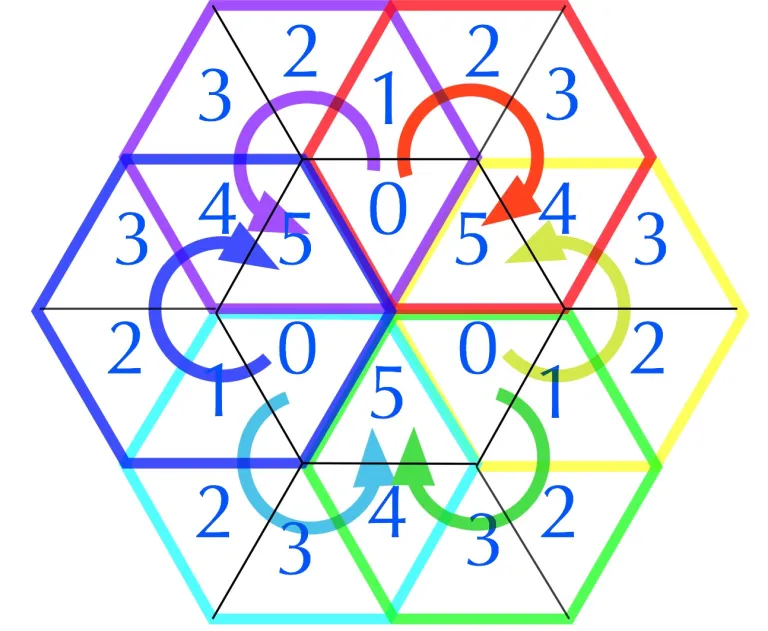
So now I will attempt to show the minor hexagons are significant. This is not easy as they are linked to the nature of prime numbers, and nothing is easy about the nature of prime numbers. But I begin with this assumption: if the hexagons participate in the Universe in any way other than haphazardly, they must be demonstrably congruent to something organized. That is, if I can show they are organized (not random) in relation to some other thing, then primes and the thing are linked. (Hexspin)
7th spin - 4th spin = (168 - 102)s = 66s = 6 x 11s = 30s + 36s
The color spin addresses for numbers are generally straightforward – a composite number takes the spin of the prior prime. 4 spins blue because 3 spins blue. 8 is red because 7 is red. However, twin primes, and the 0 type numbers between them, are open to some interpretation.

(43 - 19)the prime = 24th prime = 89
$True Prime Pairs:
(5,7), (11,13), (17,19)

layer | node | sub |  i  |  f.                                       MEC 30 / 2
------+------+-----+-----+------      ‹------------------------------ 0 {-1/2}
      |      |     |  1  | --------------------------
      |      |  1  +-----+                           |
      |  1   |     |  2  | (5)                       |
      |      |-----+-----+                           |
      |      |     |  3  |                           |
  1   +------+  2  +-----+----                       |
      |      |     |  4  |                           |
      |      +-----+-----+                           |
      |  2   |     |  5  | (7)                       |
      |      |  3  +-----+                           |
      |      |     |  6  |                          11s ‹-- ∆28 = (71-43) √
------+------+-----+-----+------      } (36)         |
      |      |     |  7  |                           |
      |      |  4  +-----+                           |
      |  3   |     |  8  | (11)                      |
      |      +-----+-----+                           |
      |      |     |  9  |‹-- ∆9 = (89-71) / 2 √     |
  2   +------|  5  +-----+-----                      |
      |      |     |  10 |                           |
      |      |-----+-----+                           |
      |  4   |     |  11 | (13) ---------------------
      |      |  6  +-----+            ‹------------------------------ 15 {0}
      |      |     |  12 |---------------------------
------+------+-----+-----+------------               |
      |      |     |  13 |                           |
      |      |  7  +-----+                           |
      |  5   |     |  14 | (17)                      |
      |      |-----+-----+                           |
      |      |     |  15 |                           7s ‹-- ∆24 = (43-19) √
  3   +------+  8  +-----+-----       } (36)         |
      |      |     |  16 |                           |
      |      |-----+-----+                           |
      |  6   |     |  17 | (19)                      |
      |      |  9  +-----+                           |
      |      |     |  18 | --------------------------
------|------|-----+-----+-----  ‹----------------------------------- 30 {+1/2}
In our approach a 3-form is not an object that exist in addition to the metric, it is the only object that exist and in particular the 4D metric, is defined by the 3-form.
- We would like to say that our present use of G2 structures (3-forms in 7D) is different from whatone can find in the literature on Kaluza–Klein compactifications of supergravity.
- We show that the resulting 4D theory is (Riemannian) General Relativity (GR) in Plebanski formulation, modulo corrections that are negligible for curvatures smaller than Planckian.
- Possibly the most interesting point of this construction is that the dimensionally reduced theory is GR with a non-zero cosmological constant, and the value of the cosmological constant is directly related to the size of . Realistic values of Λ correspond to of Planck size.
Also, in the supergravity context a 7D manifold with a G2 structure is used for compactifying the 11D supergravity down to 4D. In contrast, we compactify from 7D to 4D. (General relativity from three-forms in seven dimensions - pdf)
Think of them as rotations in different numbers of independent directions. A simple way to see the difference between U(1), SU(2), and SU(3) on Generating a Standard Model.
Opposite Behaviour
Since we are discussing about prime distribution then this 18's structure will also cover the further scheme that is inherited from the above 37 files.
This web enabled demonstration shows a polar plot of the first 20 non-trivial Riemann zeta function zeros (including Gram points) along the critical line Zeta(1/2+it) for real values of t running from 0 to 50. The consecutively labeled zeros have 50 red plot points between each, with zeros identified by concentric magenta rings scaled to show the relative distance between their values of t. Gram’s law states that the curve usually crosses the real axis once between zeros. (TheoryOfEverything)
1 + 7 + 29 = 37 = 19 + 18
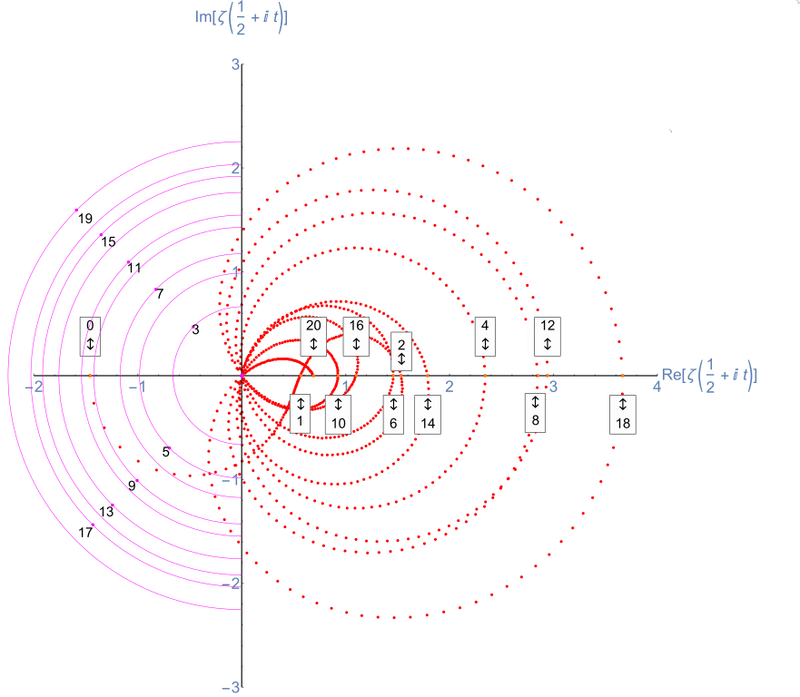
By the spin above you can see that the 4 zones of these 19's to 17's are representing the rotation 1 to 5. Such of formation can be seen on Ulam Spiral as below.
The Ulam spiral or prime spiral is a graphical depiction of the set of prime numbers, devised by mathematician Stanisław Ulam in 1963 and popularized in Martin Gardner’s Mathematical Games column in Scientific American a short time later.

By the MEC30 we will also discuss the relation of these 4 zones with high density of 40 primes where 60 number is folded.
Both Ulam and Gardner noted that the existence of such prominent lines is not unexpected, as lines in the spiral correspond to quadratic polynomials, and certain such polynomials, such as Euler’s prime-generating polynomial x²-x+41, are believed to produce a high density of prime numbers. Nevertheless, the Ulam spiral is connected with major unsolved problems in number theory such as Landau’s problems (Wikipedia).
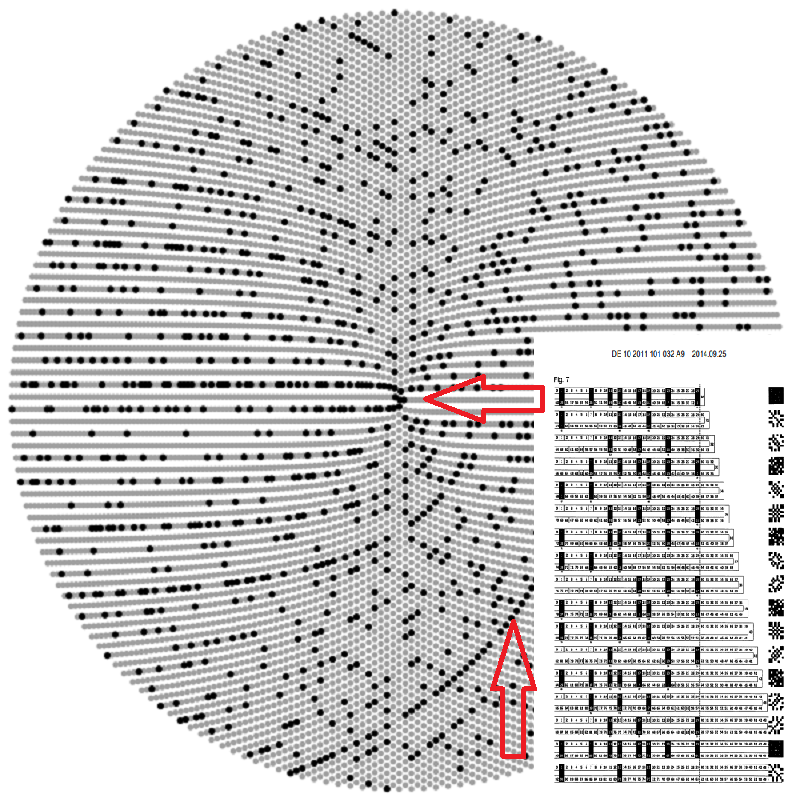
So by the eight (8) pairs of prime it will always return to the beginning position within 60+40=100 nodes per layer.
The published diagram by Feynman helped scientists track particle movements in illustrations and visual equations rather than verbose explanations. What seemed almost improbable at the time is now one of the greatest explanations of particle physics — the squiggly lines, diagrams, arrows, quarks, and cartoonish figures are now the established nomenclature and visual story that students, scientists, and readers will see when they learn about this field of science. (medium.com)
8 pairs = 8 x 2 = 16
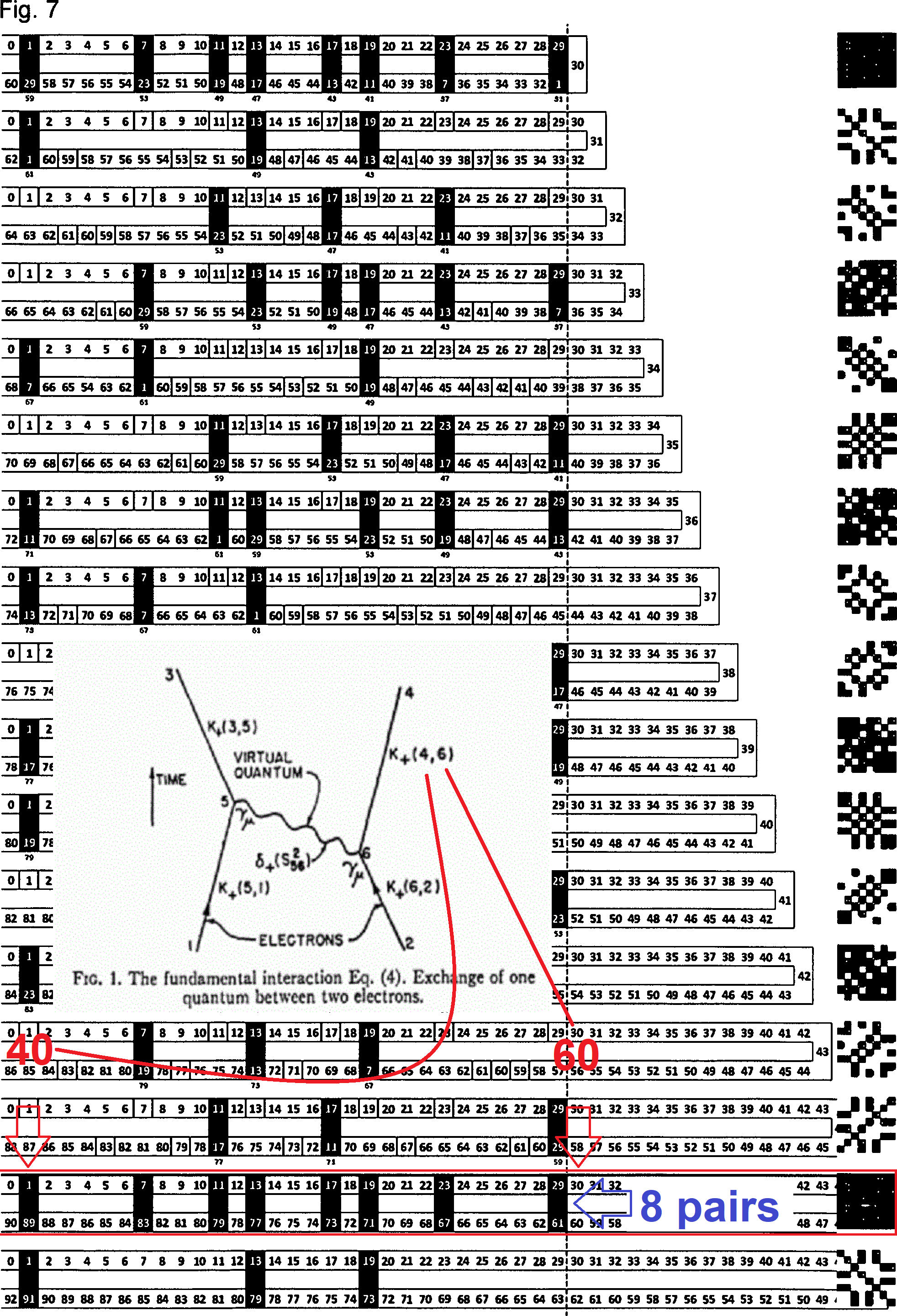
Finally we found that the loop corresponds to a quadratic polynomial originated from the 4th coupling of MEC30 which is holded by five (5) cells between 13 and 17.
In terms of Feynman diagrams it has shown that the expansion of N = 8 supergravity is in some ways a product of two N = 4 super Yang–Mills theories.
By multiplication zones we will provide a direct route to unbroken internal symmetries, generated by SU(3) x SU(2) x U(1), for one (1) generation of quarks and leptons.